1st session, 22nd-28th January 2005
Day 1
 The drive down from Auckland. Five tolerable hours followed by one hour from hell
winding endlessly along the left bank of the Whanganui river.
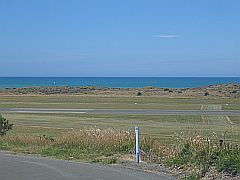
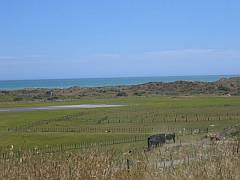
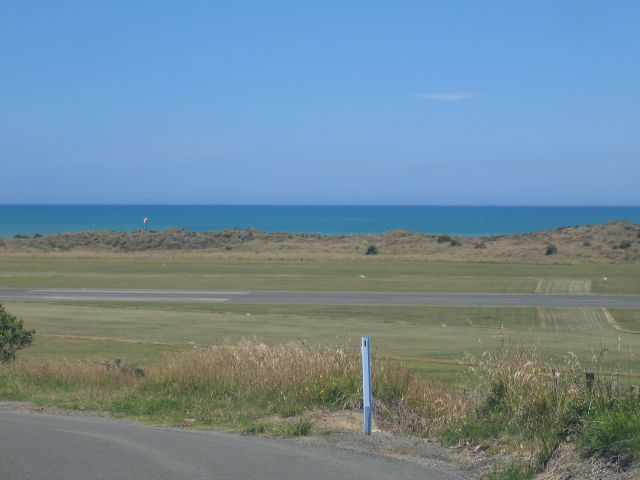
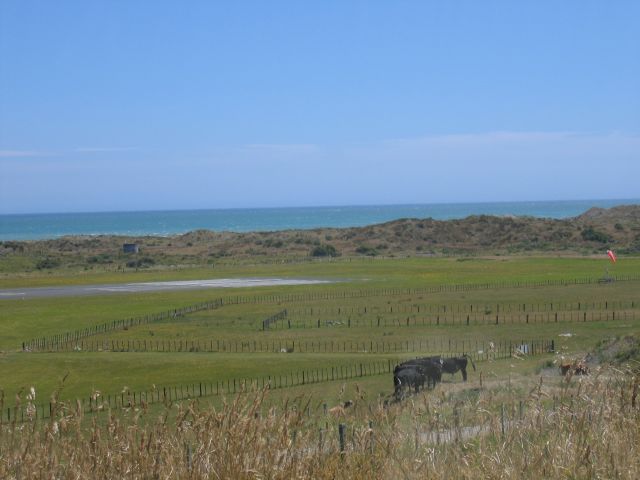
But Wanganui Airport itself is idyllic, with its main runway running parallel to the dunes and the beach. If I'd known I would have brought the surfboard.
The drive down from Auckland. Five tolerable hours followed by one hour from hell
winding endlessly along the left bank of the Whanganui river.
But Wanganui Airport itself is idyllic, with its main runway running parallel to the dunes and the beach. If I'd known I would have brought the surfboard.
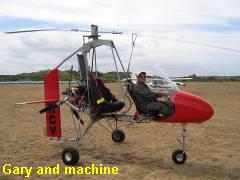
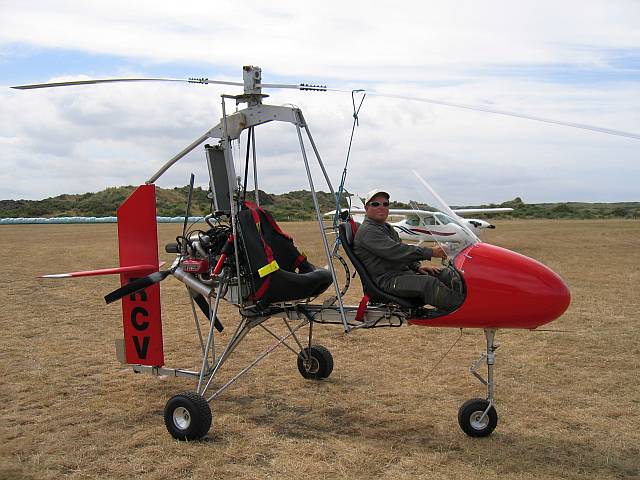
When I arrived, New Zealand's only current gyro instructor, Garry Belton and two students (Dudley Welcome and Gary McLachlan) were clustered around Gary M's
brand new Dominator II, our training machine. They were trying to resolve an intercom problem. Two hours later this was believed fixed, sort of, and the two Garrys
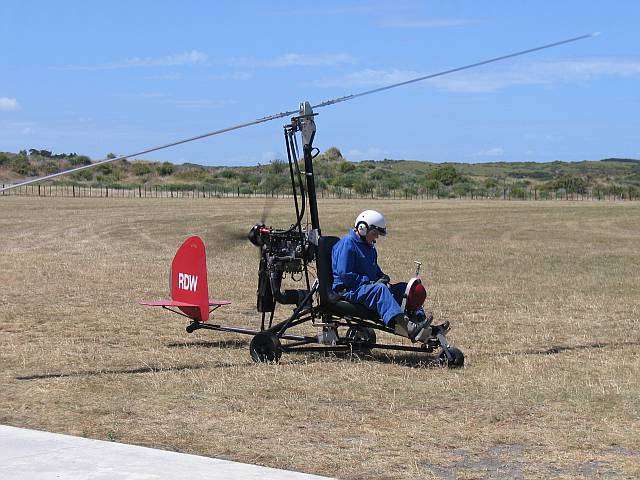
went up for a couple of circuits. I got to see (and hear) the direct-drive pre-rotator in action.
It's a noisy beast sounding not disimilar to a suspect transmission; but apparently the appalling din is all due to a rubber
belt slipping harmlessly on a nylon bushing.
Unfortunately their radio transmissions were utterly unreadable. They had to be waved back in,and we called it a day.
Back to Garry's farm a few kilometres out of Marton, and several welcome litres of home-made lemonade.
This was followed by large quantities of lasagne and other goodies provided by Garry's
unflappable wife Gay. She had something of a mission on her hands - catering for three live-in
students, and a son with a freshly broken collarbone. The flight instruction would turn out to be excelled only by the hospitality;
Hotel Belton *rocks*.
Later that evening I got down and dirty with a multimeter and discovered that the two
supposedly identical headset leads were wired
utterly differently to each other. Some rapid re-wiring was executed, and I secured my position as avionics guru.
Day 2
Up early and back out to the strip, where I got to watch & learn as Garry supervised Dudley doing crow-hops in his Air Command.
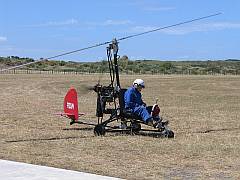
My first flight was an intro in the Dominator, out over the beach and scrub to the south;
followed by a low-level run up the beach to the airport.
This was followed by lunch at McD's, then back to the airport and the afternoon session.
Taxi practice using the brakes (bicycle hand-grips installed at foot level - ugh) followed by the most fun I've ever had in a flying machine:
Pre-rotation, and then hooning up and down the grass learning to balance on the main wheels.
On each run Garry fed in a little more throttle. On the last run I realised that for a few seconds I had roll control.
"We weren't airborne just then?"
"Yup."
We were using 11/29 seaward, which is very wide and wonderfully textured, the archetypal childhood flying
dream made real: very low over a seemingly infinite expanse of grass... the Tomahawk was never like this.
Pre-rotation was an experience in itself - as the pre-rotator is progressively engaged and those 28-foot blades spin up,
the whole machine starts shaking and bouncing. At the point where the blades just won't go any faster and the world is
one big vibrating blur, you disengage the pre-rotator and apply throttle. RCV is powered by an Autoflight Subaru
conversion, and well, moves.
After more crow hops we proceeded to circuits. Instructions: Nail the airspeed while Garry varied the throttle - no two approaches quite the same.
Everything from fly-on fixed-wing style landings to dead stop, using the rotor as the ultimate airbrake and touching down with no forward speed.
As someone once said, this feels just like sitting on a huge marshmallow :) On every takeoff, I had to fight the urge to just skim
over the grass at about 2 feet - crowhopping is incredibly addictive. This must be why at least one NZ gyro has no altimeter...
Day 3
One of the nice things about hanging around at an airport is the fantastic people you meet.
While the two Garrys were up for the first session of the day, an Aquilla trike flew in
from Fielding. I thus met Jamie Bunyan, who lost no time in taking me for a ride in his machine.
It moves like a startled cat, even two up. I think the chromed exhaust helps.
Three more sessions of circuits. Issues with the throttle on the Dominator.
At low settings it tends to stick open, mainly when taxiing towards another aircraft,
and at high settings it creeps closed if not held firmly open. Somewhat disconcerting.
Day 4
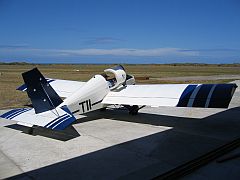 Very low cloud all morning. After an hour or two lazing around the house watching Air America ("any landing you
can walk away from is a good one"), we trundled
out to the airport. The enduring 300-ft overcast provided a fine opportunity to kick back, drink coffee and
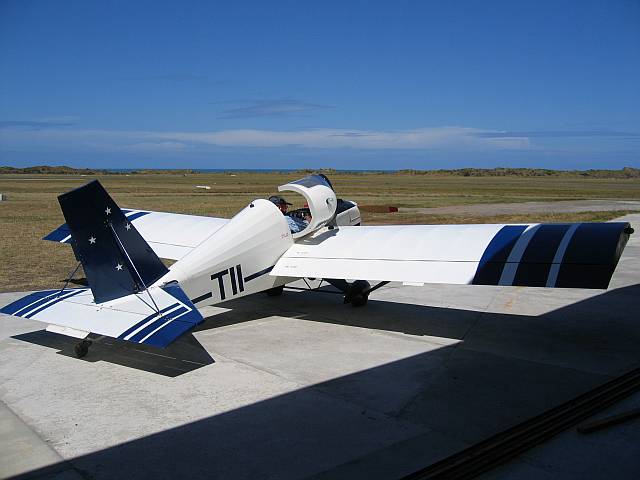
socialise with our wonderful fellow hangar-occupants, one of whom was Dave Lamplugh, his homebuilt TII and his
dog Charlie.
Very low cloud all morning. After an hour or two lazing around the house watching Air America ("any landing you
can walk away from is a good one"), we trundled
out to the airport. The enduring 300-ft overcast provided a fine opportunity to kick back, drink coffee and
socialise with our wonderful fellow hangar-occupants, one of whom was Dave Lamplugh, his homebuilt TII and his
dog Charlie.
Come the afternoon, and Garry decided it was time for some contour-flying along the beach in
the low-flying zone... flinging the gyro around chasing the surf line. This is
remarkably easy - there's just no comparison in stability and manoeuvrability to a fixed wing.
Day 5
Two session of circuits, including hovering into wind and hover-descents. This is amazing fun - you keep the nose up until
the airspeed drops to zero, and then keep position into wind by raising or lowering the nose as necessary. When you've descended
far enough, you drop the nose to gain enough airspeed/rotor RPM to flare successfully.
We were visited that morning by a large tattooed Maori gentleman on his way to collect driftwood. Upon spotting the gyro,
he drove over and wound down the window:
"That you up the beach yesterday?!"
Garry looks worried, maybe we've upset the local iwi: "Yeah, could have been..."
"F***ing awesome, eh bro!!"
Day 6
Steep turns up and down the beach. More circuits and for the first time, glide approaches and simulated engine failures.
One of these, on takeoff, had us coming down onto the beach... and just to increase the
realism, Garry didn't give me the throttle back till quite late in the exercise. There was driftwood
rushing past in a blur when I was finally allowed to climb out.
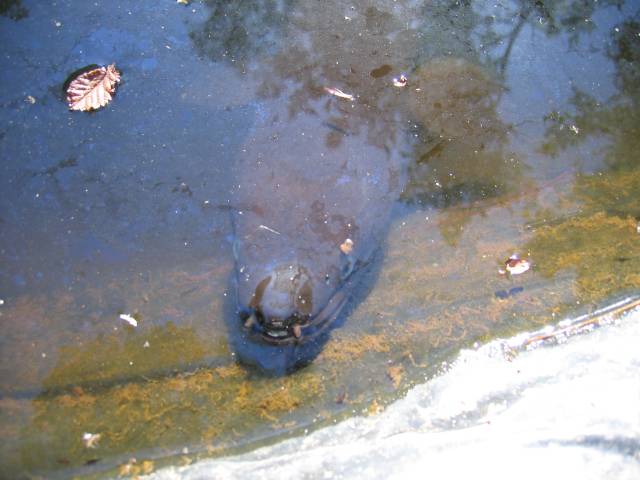
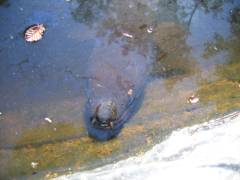 I think it was this night I was introduced to another friendly member of the Belton clan.
Day 7
For want of anything better to do, more circuits, steep turns and simulated engine outs.
At this stage a student would normally be hoping to go solo Real Soon Now - but without an aircraft of my
own, no dice. Thanks to RAF, you can no longer get insurance for gyros in New Zealand, so you really can't expect anyone to lend you theirs.
The motivation's really on to get Delta Echo finished and airborne.
 The drive down from Auckland. Five tolerable hours followed by one hour from hell
winding endlessly along the left bank of the Whanganui river.
But Wanganui Airport itself is idyllic, with its main runway running parallel to the dunes and the beach. If I'd known I would have brought the surfboard.
The drive down from Auckland. Five tolerable hours followed by one hour from hell
winding endlessly along the left bank of the Whanganui river.
But Wanganui Airport itself is idyllic, with its main runway running parallel to the dunes and the beach. If I'd known I would have brought the surfboard.